Community, not background: What helps international students integrate.
TL;DR
International students in Enschede often struggle to integrate, and the challenges aren't one-size-fits-all. I ran four methods to find out their struggles to integrate, and what would help them.
The finding showed students who found a community either through Kick-in, flatmates, or student associations, integrated faster, regardless of their background. And 79% of respondents wanted something the university isn't currently offering: a mandatory intro Dutch course.
Role
Researcher
Tools



Timeline
3 months
The problem
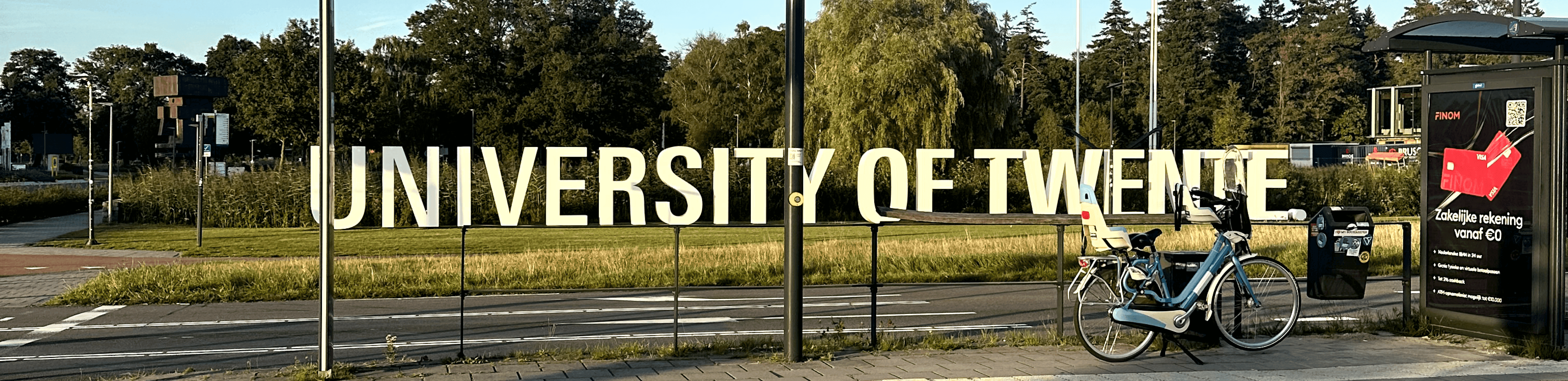
Enschede's international student population has grown significantly thanks to its universities.
But a growing population doesn't mean a well-integrated one.

Growth ≠ integration
Settling into a new country involves a hundred small frictions most people never think about.

E.g. feeling isolated/homesick, admin tasks.
Research questions
This study explores the experiences of international students in Enschede, the challenges they face integrating into the local community, and the solutions that could improve that process.
To what degree does the role of individual (whether personal or cultural or any other) differences affect students in the first month, especially for those who have never left home before?
What are the most effective ways to support international students in integrating into the local community?
Methods used
To answer these questions, I combined qualitative and quantitative methods. Each method built on the previous one, moving from exploration to validation to prioritisation.

Focus group

Survey
Interview

Card sort
Method #1
Focus group
5 participants
1 hour
In-person
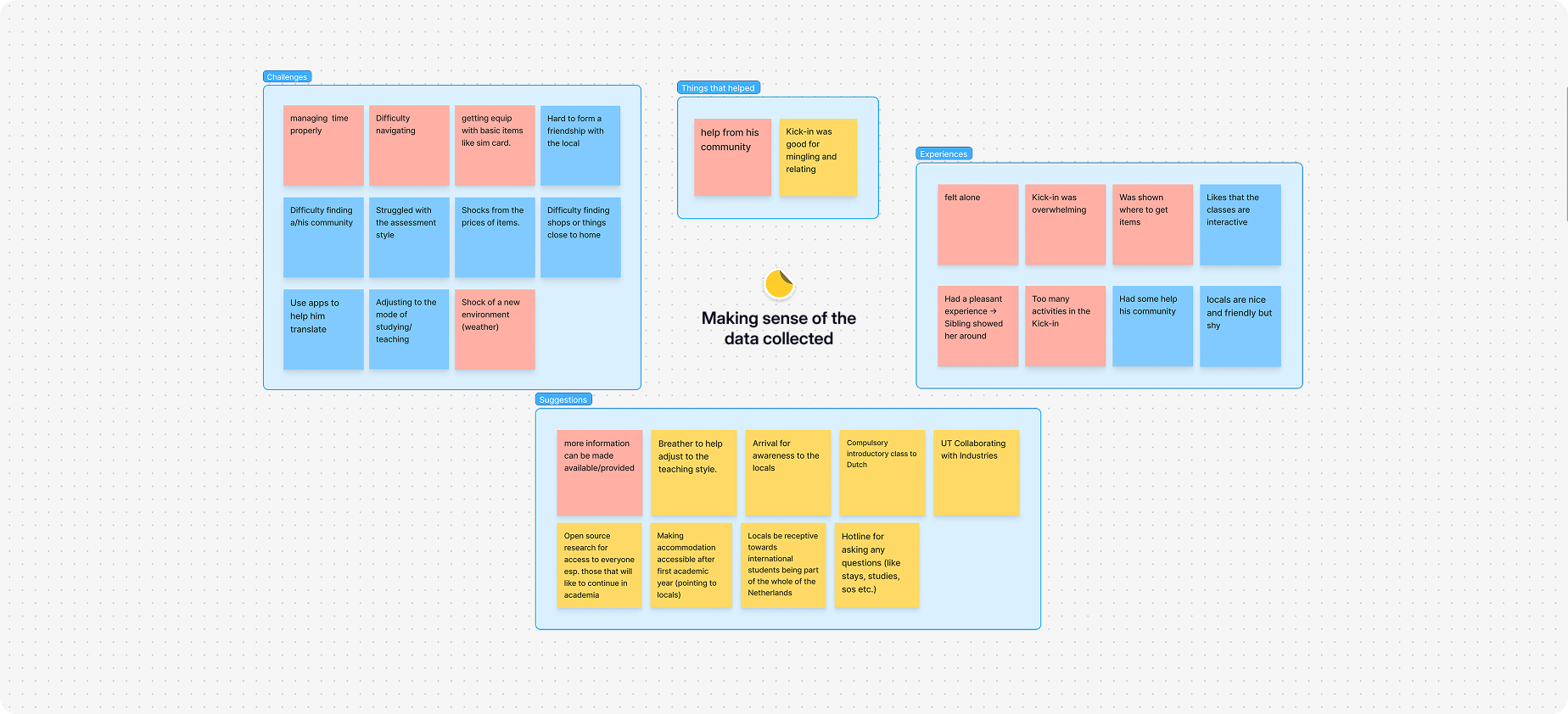
This activity was chosen as a starting point to get an holistic read on whether integration was really a challenge, and to surface directions worth digging into further. Data were collected through convenience sampling from five recently-arrived student (≤1 month in Enschede), diverse in nationality, gender, and program, in a 1-hour semi-structured session.
Everyone's experience was different, but a pattern emerged fast.
Key findings
- Participants with an existing support system (friends who arrived together, a sibling already living locally) settled in noticeably easier than those figuring it out alone.
- Dutch people were seen as friendly but hard to get close to. Kick-in helped some connect but felt overwhelming to others.
Method #2
Survey
24 respondents
18 questions
Online
The survey served as a horizon scan to better understand the general experience international students face in their first week and beyond. It also helped identify patterns of integration challenges and student opinions on a larger scale.
It was done using Google form with 18-question about experiences, differences, and support consisting primarily of closed-ended questions with very few compulsory question. It was designed to minimise participants' cognitive effort and reduce drop-offs.
Most students adapt better than expected, but a few specific gaps kept showing up.
Key findings
- Language wasn't the barrier I expected as 58% hadn't faced significant issues, since locals switch to English quickly. However, 79% still wanted a compulsory intro Dutch class.
- Participants suggested offering language support by integrating English into the city, such as translating signs, products, and public announcements in train stations and on roads.
- Support priorities ranked: academic, then social, then financial. Kick-in, student services, and buddy programs were already seen as helpful.
58%
of the participants hadn't faced significant language barriers.
58%
No language barrier
79%
of the participants wanted a compulsory intro Dutch class
79%
Wanted Dutch class
Method #3
Interview
2 participants
35–45 min
In-person
The focus group and survey revealed that people's integration experiences are similar yet unique. These findings informed some of the interview questions.
Two participants were recruited and the sessions were semi-structured and conducted in person at locations that were convenient for the participants. The first interview lasted for 35 minutes while the other for 45 minutes, and this depended on how much each participant had to say.
Whether or not someone attended Kick-in changed everything downstream.
Key findings
One participant missed Kick-in and struggled longer to integrate. The other attended, made friends through it, and felt connected faster. Both eventually leaned on flatmates and student associations, hit language friction around everyday tasks like shopping and road signs, and credited Google Maps for solving half the navigation problem. The most interesting suggestion: pair students with a Dutch buddy, not just another international one, for real exposure to Dutch culture.
Method #4
Card sort
4 participants
2 sessions
In-person
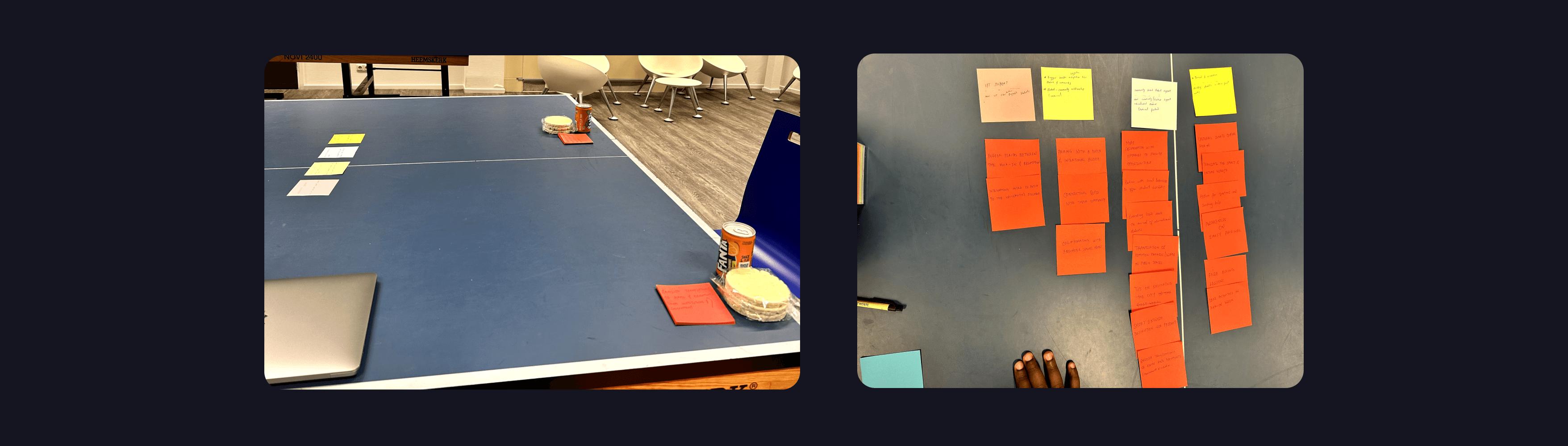
The insights from the previous research were synthesised into cards for two card sorting sessions. An open card sort was used to identify natural groupings and themes, while a closed card sort validated the resulting categories.
Key findings
The card sort validated four priority areas for improving integration.
- External support: Community initiatives that help international students integrate.
- University support: Improvements to university services and resources.
- Arrival and orientation support: Better onboarding during students' first weeks.
- Student-community relationships: Helping students build meaningful local connections
The open and closed card sorts showed strong consistency. Participants repeatedly prioritised language support, structured onboarding, and practical arrival guidance, giving confidence that these were the most important opportunities to improve the international student experience.
Results & Outcomes
Individual differences significantly shaped students' integration experiences. Students who had prior international experience abroad or strong social support adapted faster, while others experienced culture shock, loneliness, difficulty adjusting to the academic system. Language and navigation barriers were common, but technology closed most of that gap, with Google Translate and Google Maps doing a lot of quiet heavy lifting. Across all research methods, building a sense of community emerged as one of the strongest factors influencing successful integration.
The research also identified clear opportunities to improve integration. Participants consistently prioritised practical and social support, including an introductory Dutch language course, Dutch buddy programs, improved arrival guidance, English translations for essential services, and a buffer period between Kick-In and the start of classes. These recommendations were validated and prioritised through card sorting.
Reflections
- Using multiple research methods reinforced that no single method tells the whole story. By moving from exploration to validation and prioritisation, I was able to build confidence in recurring themes and produce recommendations grounded in evidence rather than individual opinions.
- If I repeated this study, I'd broaden the participant pool to include a more representative mix of international students, improving confidence that the findings apply beyond a single university context.
Integration isn't about fitting in, but it's about finding community.
These findings point at directions rather than definitive answers as this sample sizes were small and skewed.